

Voluntary early retirement is a Social Security modality that allows you to advance the retirement age up to two years with respect to the ordinary age, as long as you prove at least 35 years of contributions. Now, there is a condition that few people grant and which causes the denial of the pension and that the resulting pension once the reducing coefficientsmust be higher than the minimum pension that would correspond to the applicant according to his or her family situation upon reaching age 65.
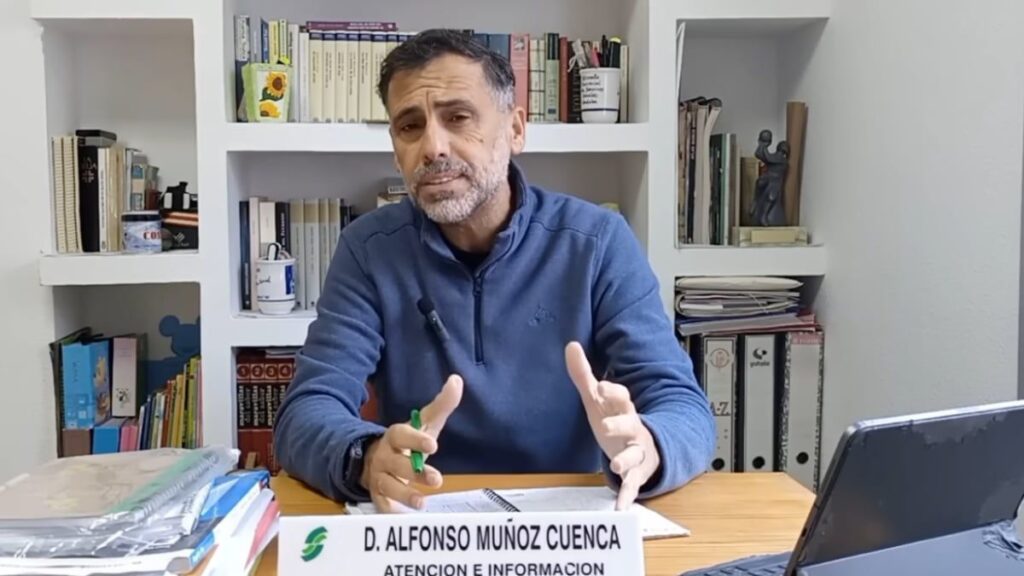
Alfonso Muñoz Cuencaan official at the National Social Security Institute specialized in pensions and benefits, explains this situation and shows a real case of the many he receives in his administration as well as in that of his co-workers, which coincide. “There have been several people I have assisted who have been denied their early retirement pension for a reason that they had never heard of and that many workers are unaware of,” says the lawyer.

Change in retirement: the CJEU forces the benefits of arduous work carried out in other EU countries to be recognized in the pension
Social Security establishes that starting in 2027 the age of involuntary early retirement will be 63 years with a penalty of up to 30%, unless you are 38 years and 6 months of contributions.
Muñoz explains, first of all, that there are mainly two types of retirement: involuntary, beyond the control of the worker and that a minimum of 33 years of contributions and six months as a job seeker is necessary, and, on the other hand, voluntary.
At this point it clarifies that “you can request two years before the ordinary retirement age, you must have at least 35 years of contributions and, the third requirement, as has happened to this person, that the amount of the resulting pension to be received is greater than the amount of the minimum pension that would correspond to the interested party based on their family situation upon reaching the age of 65.” This last point is the requirement that few are aware of, but which is included in article 208 of the General Social Security Law and which motivates the denial.

A real case of a worker with 40 years of contributions who was denied voluntary early retirement
Alfonso does not only speak with the regulations in hand, he also gives a real example, that of a 63-year-old worker with 40 years of contributions living with his wife, who neither works nor is a pensioner. According to the resolution given to him by Social Security, the amount of his early retirement pension would amount to 1,058 euros per month. Due to age and contribution career, you could retire early without any problem, but you do not meet the financial requirement.
Muñoz reviews the amounts that the administration uses as a reference. The scale depends on the pensioner’s family situation and, after the revaluation approved for 2026 by Royal Decree 241/2026, it remains as follows. A pensioner with a dependent spouse has a recognized minimum of 1,256.60 euros per month; a pensioner without a spouse, that is, single, divorced or widowed, receives 936.20 euros; and a pensioner with a spouse who is not dependent on him, 888.70 euros. This scale is linked to complement to minimums of contributory pensions and is published each year in the Royal Decree of revaluation.
When does Social Security understand that a spouse “is in charge”
According to current revaluation regulations, a pensioner is considered to have a dependent spouse when he or she does not receive a public pension and the income of any nature from the marriage, except for the amount of the applicant’s pension, is less than 11,013 euros per year. Since the wife of the worker in the example does not receive a pension or have her own income, the administration considers her dependent, which raises the minimum applicable pension floor to 1,256.60 euros per month. His theoretical pension, 1,058 euros, remains below that threshold and the application ends up being denied.
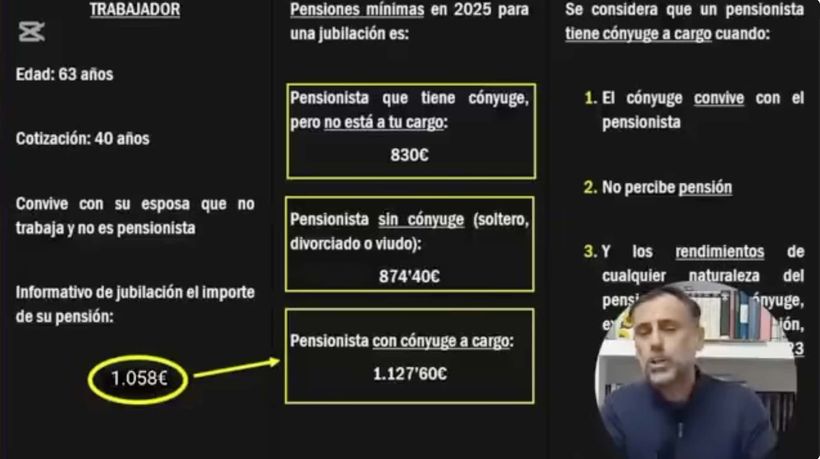
The paradox or what draws attention to the system is that, if that same family unit had income greater than 11,013 euros per year, the spouse would no longer be in charge, the applicable floor would drop to 888.70 euros and the calculated pension would comfortably exceed the minimum. In that case, the worker would access his early retirement of 1,058 euros per month. This requirement, Muñoz recalls, does not apply to involuntary or forced early retirement, where the resulting amount may remain below the minimum without preventing the recognition of the right.
“Many of you may be wondering, but how is it possible that that pensioner who does not have a dependent spouse, because his wife is working or has a higher income, is granted the early retirement pension, and that pensioner who has no income, because his wife does not work, is denied the early retirement pension,” says the official. “Well, as some television commentator says, that’s how things are and that’s how we’ve told them,” Muñoz says.