

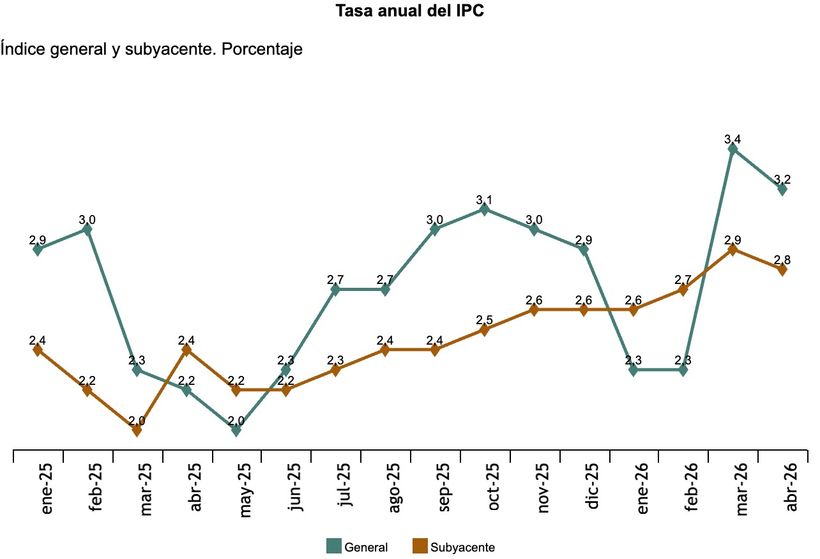
The Consumer Price Index (CPI) stood at 3.2% year-on-year in April 2026, two tenths less than in March, when it reached 3.4%. According to data published by the National Institute of Statistics (INE), the final data coincides with the ileading indicator published at the end of Aprilso the inflation moderation forecasts are met.
This drop in inflation is mainly due to the decrease in electricity prices, which have fallen more than in the same month of the previous year. Even so, transportation has continued to be one of the main drivers of price increases, raising its annual rate to 6.5%, due to the increase in the cost of fuels and lubricants for personal vehicles, compared to the drop recorded a year ago.

The Government confirms the increase in VAT on electricity and gas that will return to 21% in June
The CPI drops to 3.2% in April due to the fall in electricity despite the rise in fuel
On the other hand, the housing group has notably reduced its annual rate to 1.9%, almost two points less than in March, thanks to the performance of electricity. Recreational activities, sports and culture have also moderated their evolution, with a rate of 0.7%, due to the fact that tourist packages have increased less than in April 2025.
In monthly terms, these prices have risen 0.4% compared to March. The largest increases were recorded in restaurants and accommodation services, with an increase of 1.2%; clothing and footwear, which has increased by 6.0% due to the new spring-summer season; and transportation (motivated by the price of fuel) has had an increase of 0.9%.
On the other hand, housing has registered a monthly drop of 2.6%, driven by the decline in electricity, which has helped contain the general increase in prices.
Core inflation falls to 2.8% and the IPCA rises to 3.5%
Core inflation, which excludes fresh food and energy products, fell one tenth in April to 2.8%, remaining below the general index and reflecting a more moderate evolution of prices apart from the most volatile components.
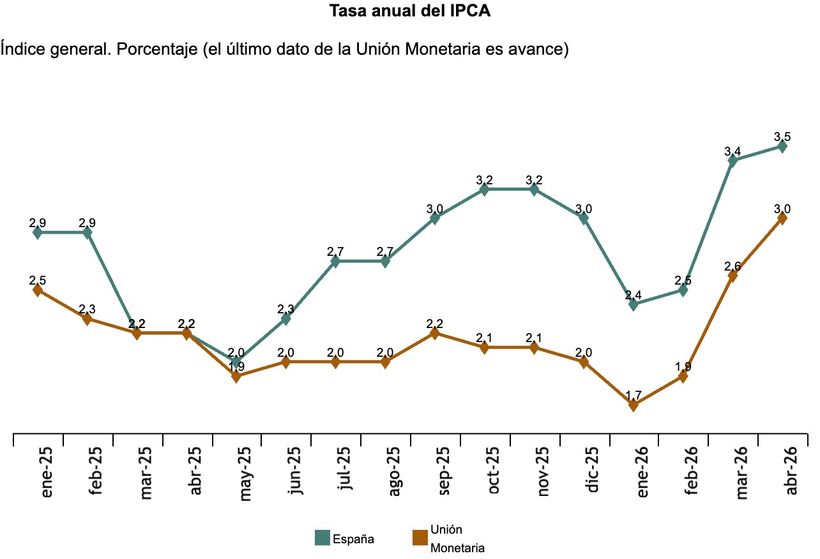
For its part, the Harmonized Consumer Price Index (IPCA), used to compare inflation between European countries, has increased to 3.5% year-on-year, one tenth more than in March. In monthly rate, the IPCA has advanced 0.7%.
Madrid once again leads the price increase
The INE points out that although all the autonomous communities have registered positive inflation rates in April, it is the Community of Madrid that has once again presented the highest rate, with 3.8%.
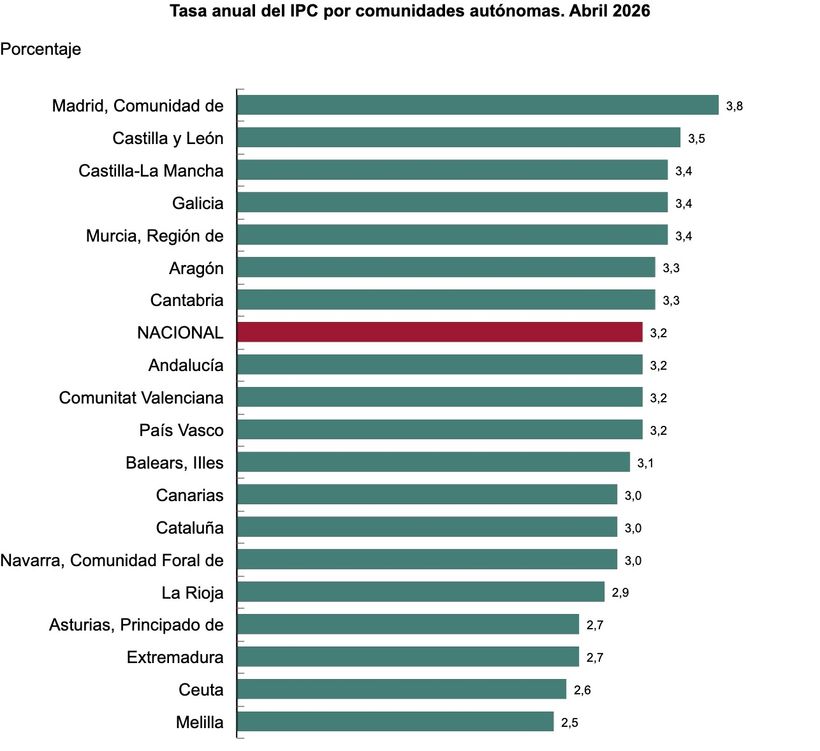
On the contrary, Asturias and Extremadura have recorded the lowest rates in the country, both with 2.7%, while the national average is 3.2%.