


Many tenants are unaware that the duration that appears in the rental contract is not always the real time they can stay in the home. Even if it is signed for a year or even less, the Urban Leases Law (LAU) establishes specific protection that allows you to continue in the property for longer, in some cases up to 7 years.
This is established by the LAU in its article 9 where it provides for a system of mandatory extensions that protects the tenant. Thus, if the contract is signed for less than 7 years and the owner is a legal entity, the rental is automatically renewed each year until that minimum legal term is reached, unless the tenant decides to leave.

It’s official: the Urban Leases Law obliges owners who sell the home to compensate the tenants

Some heiresses recover a rented apartment after the vulnerable tenant continued to occupy it with the contract expired: Justice confirms that it was not necessary for all the owners to claim the home
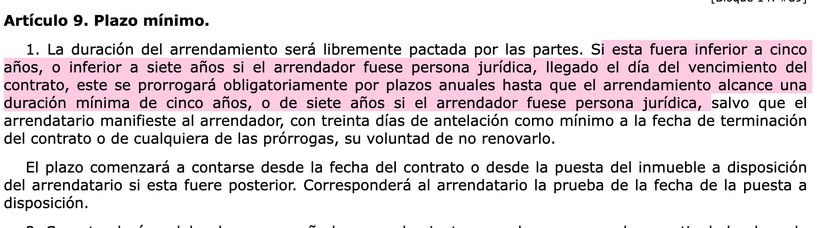
This represents one of the most important differences compared to contracts signed with private owners, where the minimum guaranteed duration is 5 years.
The tenant can leave early, but the owner company cannot avoid extensions
The LAU especially protects the tenant during that minimum period. Although the contract is automatically extended, the tenant can decide not to continue in the home “once at least six months have passed, as long as he or she notifies the landlord at least thirty days in advance,” as stated in article 11 of the law.
Of course, it must be taken into account that you may have to pay compensation to the landlord, if this was stated in the contract.
The landlord, for his part, cannot prevent these mandatory renovations until 7 years have been reached, except in very specific situations provided for by law.
Furthermore, when the owner is a company, the possibilities of recovering the home early are more limited than in the case of an individual. The exception due to the need for habitual residence, contemplated in article 9.3 of the LAU, can only be applied when the landlord is a natural person. This means that a company or company that owns it cannot claim personal or family need to recover the property during that mandatory minimum period.
After 7 years, the contract can still be extended for up to 3 more years
Once the minimum duration of 7 years has been reached, the law continues to allow the rental to continue. Article 10 of the LAU includes an additional automatic extension of up to 3 more years, through annual renewals, provided that neither party communicates its intention to terminate the contract.
To avoid this extension, the owner must notify the tenant at least four months in advance of the expiration date of the contract, while the tenant must notify it at least two months.