
For this Monday, May 11, 2026, the average price of electricity in Spain stands at 52.66 euros per megawatt hour (MWh) in the wholesale market. In this way, the week begins with an increase of 152.69%, which is 31.82 euros more compared to the price set for this Sunday, when it stood at 20.84 euros/MWh, according to data published by the Iberian Energy Market Operator (OMIE).
The wholesale market price is not what the end user pays, since it lacks tolls and taxes, which must still be applied. To know this data, which affects users with a regulated tariff (PVPC) or indexed in the free market, Red Eléctrica usually publishes it at the end of the day, information that is also provided by this medium (you can follow it on Google to be informed).
The price of electricity rises again this Tuesday with 10 time slots with electricity skyrocketing to more than 100 euros

The price of electricity today Monday, May 11, 2026 in the PVPC skyrockets and a strip will touch 350 euros
When will electricity be cheaper this Monday?
For this Monday, May 11, the cheapest time will take place between 4:00 p.m. and 5:00 p.m., when the price will be 0.14 euros/MWh. We must also take into account the hours between 3:00 p.m. and 4:00 p.m., when it will be 0.68 euros/MWh, and the section from 5:00 p.m. to 6:00 p.m., with a price of 1.20 euros/MWh.
When will electricity be more expensive?
On the other hand, the most expensive hour will be from 9:00 p.m. to 10:00 p.m., when it will have a cost of 187.57 euros/MWh. Furthermore, it is advisable to avoid the sections located between 10:00 p.m. and 12:00 p.m., where the average price will be 128.85 euros/MWh.
Hourly electricity price, Monday, May 11
For this Monday, the most economical time slots will be in the central hours of the day, between 11:00 a.m. and 6:00 p.m., with values that sink below 5 euros/MWh thanks to the strong solar contribution. From there, electricity will skyrocket, exceeding, in five of the last six bands, the 100 euro barrier, thus being the worst hours to plug in appliances.
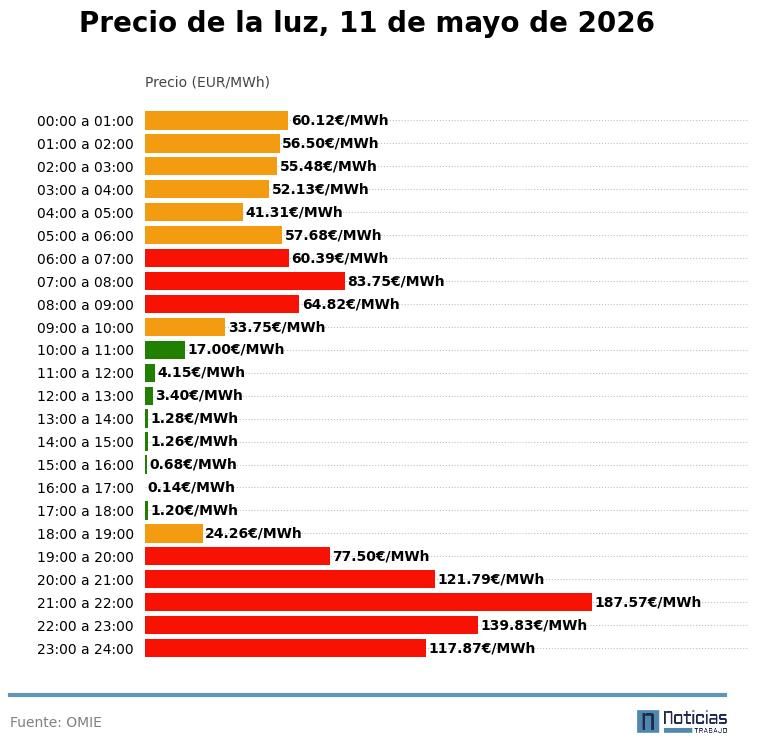
- 00:00 to 01:00: 60.12 euros/MWh
- 01:00 to 02:00: 56.50 euros/MWh
- 02:00 to 03:00: 55.48 euros/MWh
- 03:00 to 04:00: 52.13 euros/MWh
- 04:00 to 05:00: 41.31 euros/MWh
- 05:00 to 06:00: 57.68 euros/MWh
- 06:00 to 07:00: 60.39 euros/MWh
- 07:00 to 08:00: 83.75 euros/MWh
- 08:00 to 09:00: 64.82 euros/MWh
- 09:00 to 10:00: 33.75 euros/MWh
- 10:00 to 11:00: 17.00 euros/MWh
- 11:00 to 12:00: 4.15 euros/MWh
- 12:00 to 13:00: 3.40 euros/MWh
- 1:00 p.m. to 2:00 p.m.: 1.29 euros/MWh
- 2:00 p.m. to 3:00 p.m.: 1.26 euros/MWh
- 15:00 to 16:00: 0.68 euros/MWh
- 16:00 to 17:00: 0.14 euros/MWh
- 17:00 to 18:00: 1.20 euros/MWh
- 18:00 to 19:00: 24.26 euros/MWh
- 19:00 to 20:00: 77.50 euros/MWh
- 20:00 to 21:00: 121.79 euros/MWh
- 21:00 to 22:00: 187.57 euros/MWh
- 22:00 to 23:00: 139.83 euros/MWh
- 23:00 to 24:00: 117.87 euros/MWh
Evolution of the price of electricity during the first 11 days of May
The average price during these first 11 days of May has stood at 56.24 euros/MWh, which means that electricity is now 35.10 euros more expensive than a year ago, when the average price was €21.14/MWh.
If today’s day is compared to just a year ago, there is a decrease of 47.74%. This is because on May 11, 2025 the price of electricity stood at €96.94/MWh, while the price today stands at €50.66/MWh, which represents a drop of €46.28 compared to the same date last year.
| Date | 2025 | 2026 | Difference in euros/MWh |
|---|---|---|---|
| May 1 | 13.29 | 57.87 | 44.58 |
| May 2 | 10.94 | 43.64 | 32.70 |
| May 3 | 16,17 | 48.13 | 31.96 |
| May 4 | 11 | 69.71 | 58.71 |
| May 5 | 10.89 | 64.34 | 53.45 |
| May 6 | 10.24 | 78.02 | 67.96 |
| May 7 | 19.01 | 86.90 | 67.89 |
| May 8 | 16.76 | 64.69 | 47.92 |
| May 9 | 18.24 | 33.80 | 15.56 |
| May 10 | 9.08 | 20.84 | 11.76 |
| May 11 | 96.94 | 50.66 | -46.28 |
The conflict in the Middle East and its effect on the electricity bill
When the electricity goes up, many families do not think about international markets or how the price of electricity is set. What they see is that putting on a washing machine, turning on the oven or using the heating costs more than it did a few days ago. And behind these increases, many times, there are factors that seem distant, such as the conflict in the Middle East.
The relationship is in natural gas. If tension increases in a key area for global energy supply, the markets react quickly and gas becomes more expensive. Although Spain does not depend only on that region, the price of this raw material moves in a global market, so any uncertainty ends up being noticed.
This increase in prices reaches the electricity market because gas plants usually set the price when they are necessary to cover demand. Thus, although part of the electricity is generated with renewable or nuclear power, the final cost may increase if gas is used and is more expensive.
The result is noticed especially by those who have a regulated tariff or PVPC. Although now the bill also depends on longer-term references, the daily price of electricity continues to weigh heavily. For this reason, an international crisis that seems far away ends up appearing in something as everyday as the bill at the end of the month.