
With the fall of extraordinary extensions of rental contracts in Congress Last week, many landlords and tenants had questions about the maximum duration of rentals. This issue is regulated in the Urban Leases Law (LAU), which establishes not only the minimum duration, but also how and for how long they can be extended.
Firstly, the regulations establish a mandatory minimum duration. Article 9.1 establishes that, even if the contract is signed for a shorter period, it will be automatically extended year by year until it reaches 5 years in duration, or 7 years if the lessor is a legal entity.
A landlady cannot recover her home for her own use before the contract ends if she does not justify the need: Justice clarifies that it is not enough to allege personal reasons

Ibiza leaves 200 workers who survived in vans on the streets because they could not afford to pay rent
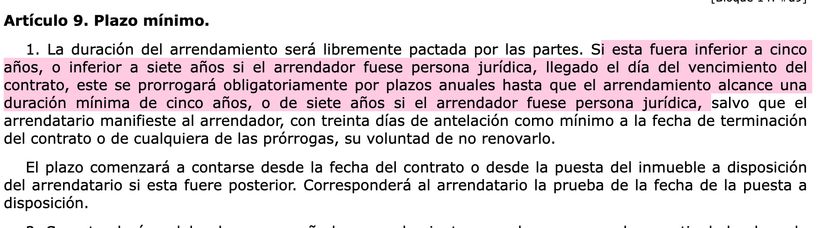
In practice, this means that a one-year contract does not force the tenant to leave the home at the end of that period, since they have the right to continue in the property until completing that legal minimum. Furthermore, this extension works as a right of the tenant, so the owner cannot prevent it as long as the conditions established by law are met.
Once this mandatory minimum period is reached, the contract does not automatically end. For it to end, it is necessary for one of the parties to communicate their willingness not to renew it within the legal deadlines.
After 5 or 7 years, the contract can continue to be extended for up to 3 more years
Article 10.1 of the Urban Leasing Law establishes that, if none of the parties communicates their desire not to renew, the contract is automatically extended. In these cases, the landlord must give at least 4 months’ notice if he does not want to renew the contract, while the tenant must give at least 2 months’ notice.
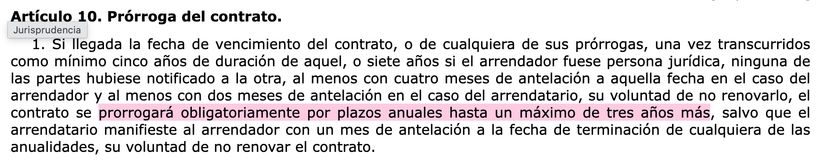
If this notice is not given on time, the contract does not expire, but rather enters a new extension phase. However, it is important to clarify that this extension does not imply that the contract is automatically extended by 3 full years. The law establishes that it occurs for annual periods, that is, the contract is renewed year by year up to a maximum of 3 additional years.
During this period, the tenant may decide not to continue in the home for any of these annuities, as long as they communicate this at least one month in advance before the end of the contract or each extension.
At the same time, the owner cannot recover the home during those years if he has not given notice in time, except in the exceptional cases provided for by law, such as the need to use it as a habitual residence under certain conditions or in case of breach of contract by the tenant.
In practice, this means that the contract can be extended beyond the initial 5 or 7 years, but always through annual extensions. Therefore, if the landlord does not give 4 months’ notice, the contract does not end, but can continue to be extended year by year up to a maximum of 3 more years.