The average price of electricity for this Wednesday, May 6, 2026 rises to 78.02 euros per megawatt hour (euros/MWh). When compared to the rate of this Tuesday, May 5, it can be seen that electricity has increased by 21.27%which means paying 13.68 euros more to your pocket, according to official data published by the Iberian Energy Market Operator (OMIE).
What time is electricity cheaper this Wednesday?
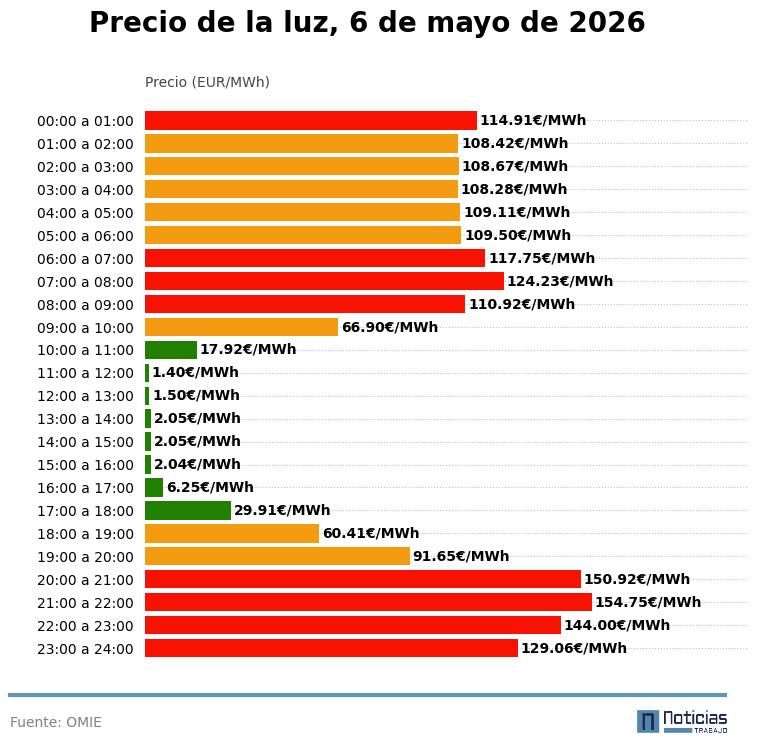
The cheapest time of electricity will be from 11:00 a.m. to 12:00 p.m. with a price of 1.40 euros/MWh and the best times to use electricity will be, once again, at midday and late in the morning.
The price of electricity today Thursday, May 7, 2026 in the PVPC rises again, with 4 sections above 200 euros
The price of electricity this Thursday, May 7, rises and there will be no section below 15 euros
When is electricity most expensive?
The most expensive hour for electricity will be from 9:00 p.m. to 10:00 p.m. when it will be paid at 154.75 euros/MWh. You will have to be careful in the late afternoon and evening hours since at those times the light is triggered and will cost more than 100 euros.
Price of electricity by hour, Wednesday, May 6
To achieve real savings on the bill, the ideal is to know the price of electricity hour by hour during the 24 time slots of the day. It is essential to be organized and avoid late afternoons and nights as it will cost more money. Once again, midday is the best time to save money and turn on your appliances.
All this can be verified in the following graph and list made with official OMIE data.
| Hour | Price |
|---|---|
| 00:00 to 01:00 | 114.91 euros/MWh |
| 01:00 to 02:00 | 108.42 euros/MWh |
| 02:00 to 03:00 | 108.67 euros/MWh |
| 03:00 to 04:00 | 108.28 euros/MWh |
| 04:00 to 05:00 | 109.11 euros/MWh |
| 05:00 to 06:00 | 109.50 euros/MWh |
| 06:00 to 07:00 | 117.75 euros/MWh |
| 07:00 to 08:00 | 124.23 euros/MWh |
| 08:00 to 09:00 | 110.92 euros/MWh |
| 09:00 to 10:00 | 66.90 euros/MWh |
| 10:00 to 11:00 | 17.92 euros/MWh |
| 11:00 to 12:00 | 1.40 euros/MWh |
| 12:00 to 13:00 | 1.50 euros/MWh |
| 1:00 p.m. to 2:00 p.m. | 2.05 euros/MWh |
| 2:00 p.m. to 3:00 p.m. | 2.05 euros/MWh |
| 15:00 to 16:00 | 2.04 euros/MWh |
| 16:00 to 17:00 | 6.25 euros/MWh |
| 17:00 to 18:00 | 29.91 euros/MWh |
| 18:00 to 19:00 | 60.41 euros/MWh |
| 19:00 to 20:00 | 91.65 euros/MWh |
| 20:00 to 21:00 | 150.92 euros/MWh |
| 9:00 p.m. to 10:00 p.m. | 154.75 euros/MWh |
| 22:00 to 23:00 | 144.00 euros/MWh |
| 23:00 to 24:00 | 129.06 euros/MWh |
Evolution of the price of electricity during the first 6 days of May
During the first 6 days of the month of May, the average price of electricity has been 60.29 euros, so it can be said that we now pay 48.2 euros more. Exactly a year ago, the average was 12.09 euros.
When compared to a year ago, electricity is 398.7% more expensive since in May 2026 the pool price was 10.24 euros per megawatt hour.
| Date | 2025 | 2026 | Difference in euros/MWh |
|---|---|---|---|
| May 1 | 13.29 | 57.87 | 44.58 |
| May 2 | 10.94 | 43.64 | 32.70 |
| May 3 | 16,17 | 48.13 | 31.96 |
| May 4 | 11 | 69.71 | 58.71 |
| May 5 | 10.89 | 64.34 | 53.45 |
| May 6 | 10.24 | 78.02 | 67.96 |
Renewables are at the forefront of electricity generation
Renewable energies once again dominated electricity generation in Spain during April, reaching 59.8% of the total with 12,126 GWh produced. Photovoltaic solar was the main source, after increasing its production by 24.2%, and contributing 25% of the energy mix, ahead of nuclear (19.1%) and wind (18%). Overall, almost 79% of the electricity generated was free of CO₂ emissions.
If self-consumption production is included, the share of renewables rises to 61.3%. In addition, energy storage systems, such as batteries and pumping, allowed 1,128 GWh to be integrated into the network, facilitating better use of renewable energy. For its part, electricity demand decreased by 2.1% in adjusted terms, standing at 18,561 GWh, while self-consumption generated around 1,233 GWh.
In the Balearic Islands, electricity demand grew by 1.4% in April, with an increase of 3.9% in gross terms. The combined cycle was the main generation source, with 63.9%, followed by photovoltaic solar, which grew strongly and reached 17.9% of the mix. Renewables in the archipelago increased by 27.7% year-on-year and achieved a record share of 22.9%.
In the Canary Islands, electricity demand also increased by 1%, while generation was led by the combined cycle (41.9%). Wind contributed 11.7% and solar 5.7%, placing the total weight of renewables at 17.4% of the mix. Thus, although with less presence than in the peninsula, clean energies continue to gain ground in both archipelagos.