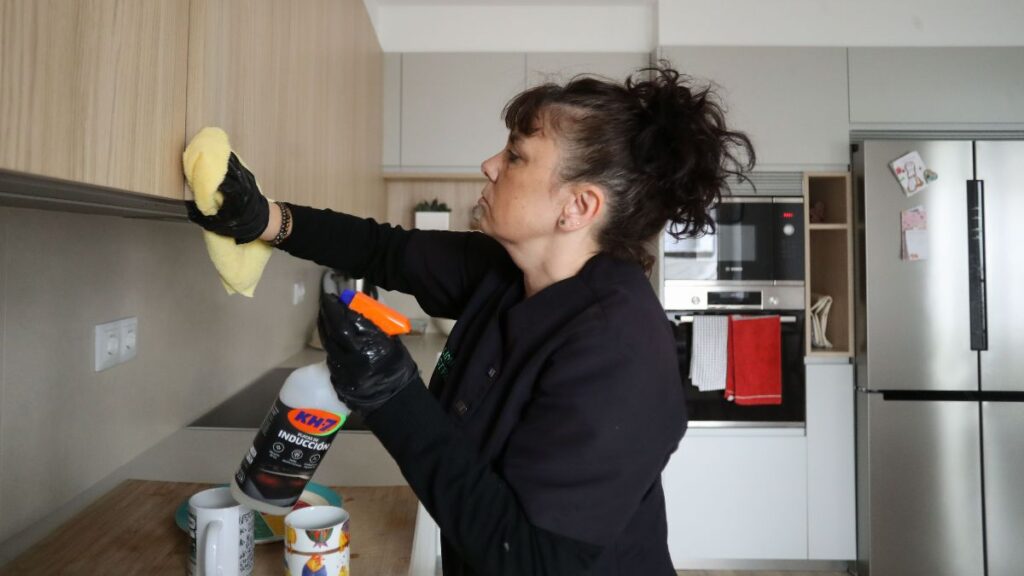
The Superior Court of Justice of Catalonia has denied the permanent disability pension to a domestic worker for her lung and muscle sequelae resulting from a serious Covid-19 infection. For the court, his injuries do not prevent him from carrying out the fundamental tasks of his job, since some of them were not considered accredited.
The employee, born in 1978, worked as a domestic worker and her contract ended in May 2023 due to the death of her employer. Previously, in May 2021, he began a period of temporary disability due to a Covid-19 infection. The infection was serious, requiring admission to the ICU and intubation, which caused critical patient myopathy and, as the main sequel, dyspnea (difficulty breathing) with great exertion. Complementary tests indicated a functional capacity of 9 METS and an ejection fraction of 60%.
As a result, he requested a permanent disability pension from the National Social Security Institute (INSS), but it was denied in May 2023, considering that his injuries did not reach a sufficient degree of reduction in his work capacity. As the subsequent claim was also rejected, he went to court, but the Social Court No. 28 of Barcelona also dismissed his claim in March 2025.
Appeal the sentence to request permanent disability
The domestic worker decided to appeal this first ruling and filed a petition before the Superior Court of Justice of Catalonia. In this, he requested that the report of his injuries be modified to include much more serious sequelae, such as dyspnea with minimal and medium effort, asthenia, generalized weakness, tremors, chronic cough and morphological lung lesions secondary to COVID-19. To do this, she relied on a pulmonology report and a chest CT scan provided by her.
Likewise, she alleged that Article 194 of the General Social Security Law was improperly applied, arguing that its consequences do disqualify her from the fundamental tasks of her profession.
The TSJ of Catalonia denies him permanent disability
The Superior Court of Justice of Catalonia explained that, for a higher court to modify the facts, the judge’s error must be evident and indisputable through documents with exclusive probative value. In this sense, he concluded that there was no such error, since the trial judge based his decision on the expert report of the managing entity (INSS), granting it greater probative value than the private reports provided by it.
Therefore, the recognized injuries remained unchanged (dyspnea with great exertion and negative complementary examinations). Regarding total permanent disability, he recalled that its recognition requires that the worker be disqualified from performing all or the fundamental tasks of his or her usual profession.
Taking into account this, the TSJ determined that, when comparing the consequences that are proven as being with the physical demands of a domestic worker, there was no permanent, serious or severe limitation that would prevent her from working. The court noted that, although in periods of worsening (exacerbation) the worker may need medical leave (temporary disability), her current chronic injuries are not sufficient to grant her a lifetime pension for permanent disability.
Consequently, it dismissed her appeal and acquitted the INSS, confirming that she did not deserve a permanent disability pension for her usual profession. This ruling (STS CAT 2798/2026) was not final and an appeal could be filed against it for the unification of doctrine before the Supreme Court.