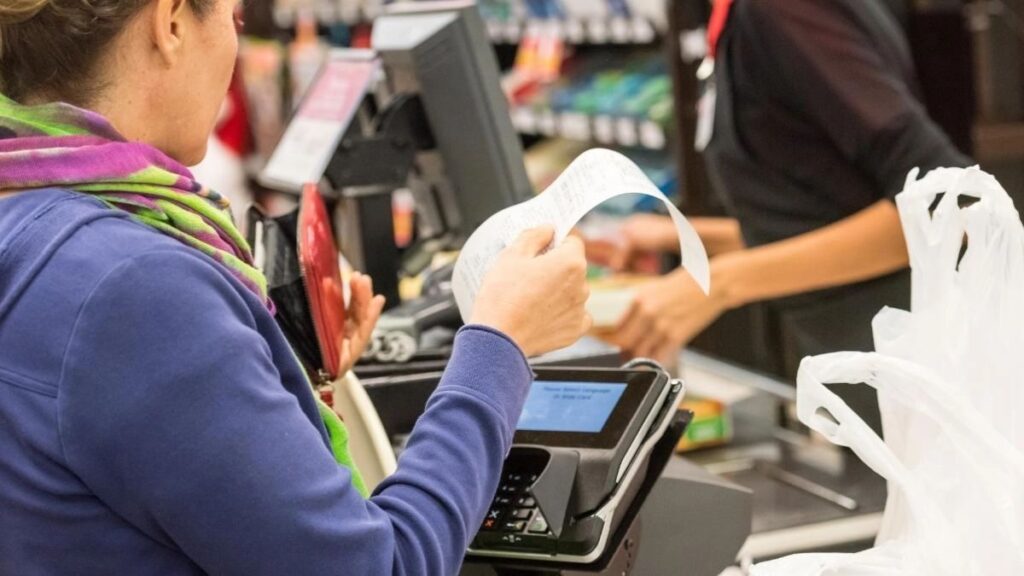
In the midst of the transformation of consumer habits, increasingly marked by digital technology, supermarkets have now focused on the purchase receipt. What for decades, receiving the paper receipt when paying has been an automatic gesture, is beginning to be reconsidered as part of this change in model. However, the change does not convince everyone, especially those who believe that something as simple as reviewing the purchase can end up becoming more complicated than it seems.
The proposal of the Spanish Association of Distributors, Self-service and Supermarkets (Asedas), the supermarket association to modify the regulations that require automatic printing of the purchase receipthas opened a debate about the limits of digitalization in daily consumption.
The organization, which brings together large chains such as Lidl, Dia or Aldi, proposes that the receipt become digital by default and that the paper only be issued at the request of the customer. Faced with the environmental argument, senior associations, experts and consumer organizations warn of risks of exclusion, loss of privacy and weakening of basic rights.
Between paper savings and customer guarantee
In this way, if the paper ticket was eliminated in supermarkets in Spain, after payment, the consumer would receive the ticket only if they expressly request it or if they opt for its digital version. According to Asedas, the measure responds to sustainability criteria, with the saving of thousands of tons of paper per year, and the realization that a large part of the tickets end up discarded without use. In fact, this model has already been implemented in countries such as France or the Netherlands.
However, various organizations point out that the ticket is not only waste, but a common instrument for expense control and legal guarantee. The Spanish Confederation of Seniors’ Organizations (CEOMA) defines it as a tool of “autonomy and security”, while the Platform for Seniors and Pensioners (PMP) warns of the risks associated with demanding personal data, such as email, in a context of increased cyber fraud.
The risks pointed out by experts and consumers
Thus, in this case, the possible replacement of the physical ticket with the digital one could worsen the technology gapespecially among older people who do not use smartphones or applications. The promoter of the ‘I am older, not an idiot’ movement, Carlos San Juan, interprets the initiative as a cost reduction strategy that could lead to exclusion. “Different opportunities are being given depending on the capabilities of each person,” he warns, according to ’65YMORE’.
Adding to this concern is the issue of privacy. Experts in digital inclusion, such as those responsible for the SeniorTic association, point out that the digital model involves the transfer of personal data that can be used for commercial purposes. The consumption trail, converted into an economic asset, introduces an additional element in the relationship between customer and company.
From the legal field, Law professor Vanesa Morente, from Comillas ICADE, remembers that current legislation recognizes the right to receive the paper ticket. Any modification, as he emphasizes, would require regulatory changes and should guarantee a “hybrid and gradual” implementation. Otherwise, he warns that an “ageing” effect could occur if the digital format is imposed de facto as the only option.
Along the same lines, the researcher at the Open University of Catalonia, Mireia Fernández-Ardèvol, points to the social implications of the measure. Making the digital ticket the default option could generate situations of friction at the checkouts and possible stigmatization of those who request the paper, forced to justify themselves or assume longer waiting times.
For their part, consumer associations, such as the OCU or CECU, agree that the key lies in voluntariness. The paper ticket, they maintain, cannot become a residual option or a conditional right, since it constitutes essential proof of the contractual relationship.