Temporary disability or, what we also know as sick leave, have become one of the great determinants of the labor market in Spain, whose Social Security evaluates both its cost and its management by companies. The Independent Authority for Fiscal Responsibility (AIReF) has already warned that this benefit is the second largest expense of Social Security, with more than 16.5 billion euros in 2024, a figure that continues to grow year after year.
That increase is not minor. Between 2017 and 2024, the incidence of sick leave has grown by almost 60% and the average duration has gone from 40 to 45.9 days, according to the report published by AIReF. The problem, therefore, is no longer temporary, but structural.
However, the European comparison begins to leave an idea that may be uncomfortable for Spain and it is none other than that our country does not stand out precisely for protecting more, but for managing the entire process of sick leave worse. Germany, without a doubt, is one of the countries to follow, along with others such as the Netherlands or Sweden, when it comes to temporary disability management, since the data demonstrate a more effective system.
Germany does not reduce rights, improves control
In recent years, Germany has been singled out for an increase in sick leave. But the compared data dismantles that perception. According to the European analysis based on OECD statistics, the country registers around 3.6 weeks of sick leave per year per worker, a figure that remains within the average of advanced economies.
Spain, on the other hand, is close to 5 weeks per year, clearly above the European average of 2.6 weeks. The difference is not so much in the design of the system, but in how it is measured and controlled.
In fact, part of the German increase is explained by the digitalization of medical reports, which has allowed casualties to emerge that were not previously recorded. That is to say, rather than a real increase in absenteeism, what there is is a more transparent and monitored system.
The myth of cuts: they don’t work
One of the recurring debates in Spain is whether the casualties should be toughened, especially in the first days. However, European evidence points in the opposite direction.
The harmonized data of the OECD, through the comparative study carried out by the Betriebsratshow that there is no direct relationship between the days without pay at the beginning of the leave and a reduction in absenteeism.
This breaks one of the main arguments of the public debate. Countries with tougher systems do not necessarily have fewer casualties. And in some cases the opposite happens.
The clearest example is the contrast between Spain and other European countries where they are paid from the first day and, even so, they register fewer weeks of absence. The conclusion is clear: financially penalizing the worker does not solve the underlying problem.
Spain’s real failure is in the system
If there is one point where experts agree, it is in the structural diagnosis. AIReF directly points out that the Spanish system presents a lack of coordination, supervision and integrated information between the different actors.
This has very concrete consequences. The medical decision, the economic cost and the monitoring of the process are distributed among different organizations that do not always share information in real time. This design makes control difficult and encourages some processes to take longer than necessary.
Furthermore, the study itself detects that the losses are increasingly concentrated in certain profiles and that the repetition of episodes is a key factor. This is shown by the determining factors of temporary disability in Spain from the AIREF study.
The key is not to pay less, but to act sooner
Faced with this model, the most effective countries managing temporary disability in Europe have another approach and it is none other than intervening before and accompanying the entire sick leave process.
The AIReF insists on this same idea by proposing to reinforce early control, improve coordination between administrations and promote gradual return to work programs.
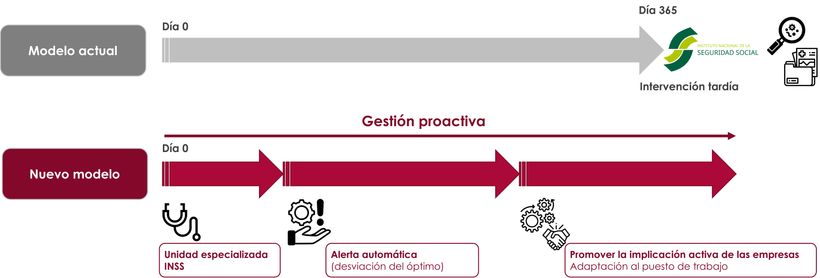
This change of focus is key. It is not about cutting the benefit in the first days, but rather about preventing withdrawals from becoming long and uncontrolled processes.
The real lesson for Spain
The comparison with Europe leaves a conclusion that is difficult to ignore. While Spain continues to focus the debate on how much the loss costs and how to limit it, other countries have focused on how to better manage it.
Germany does not have a tougher system, but it does have a more orderly, more transparent and with greater monitoring from the beginning. And therein lies the difference.
The lesson for Spain and its pending issue regarding sick leave is clear: the problem of sick leave is not corrected with fewer rights, but with more control, better information and a real return to work strategy.