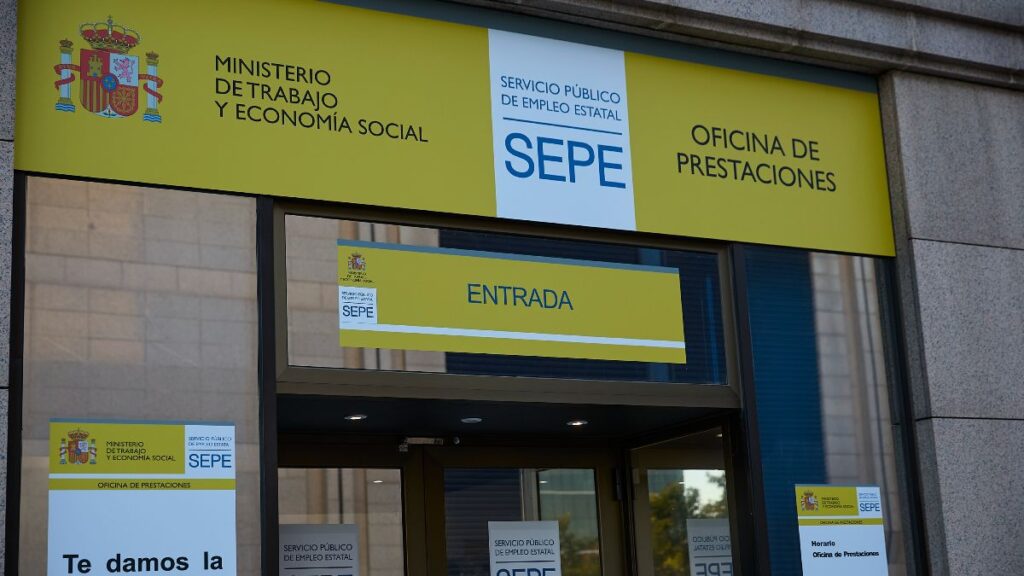
A beneficiary of unemployment benefit You will have to return part of the money collected after obtaining income from the sale of a home without communicating it in time to the State Public Employment Service (SEPE). The Superior Court of Justice of Madrid has endorsed the agency’s actions by considering that the lack of immediate communication of this income justifies the termination of the aid and the claim for undue amounts.
According to the ruling of December 2025, the woman had been granted unemployment benefit since 2019. During 2021 she obtained a capital gain of 30,954.90 euros as a result of the dissolution of the co-ownership of a home, in addition to another minor gain from the sale of a property. However, it did not communicate these income to the SEPE at the time it occurred, but more than a year later, when presenting its annual income statement.
As a result of this situation, the SEPE reviewed its file and agreed to terminate the subsidy, upon verifying that these incomes exceeded the limit allowed to continue receiving the aid, set at 75% of the Minimum Interprofessional Wage. In addition, he claimed 10,055.13 euros for improper charges corresponding to the period between 2021 and 2022.
The beneficiary appealed this decision, alleging that the income had been declared in the personal income tax and that there was no concealment, but the Administration maintained its criteria, understanding that the legal obligation is not limited to declaring the income, but also to communicate it at the time it is generated.
The TSJ confirms the termination of the subsidy and requires reporting the income at the time it occurs
The Superior Court of Justice of Madrid supported the SEPE criteria when applying the regulations on unemployment benefits, specifically article 279.3 of the General Social Security Law (LGSS), which establishes that the subsidy is extinguished when the beneficiary exceeds the income limits for a prolonged period.
Furthermore, the ruling was based on articles 25.3 and 47.1.b) of the Law on Infringements and Sanctions in the Social Order (LISOS), which classify as a serious infraction failure to communicate in time the situations that affect the right to the benefit, and provide as a sanction the termination of the subsidy and the return of amounts unduly received.
This interpretation was also based on the consolidated doctrine of the Supreme Court, which differentiates between late communication and lack of communication. According to this jurisprudence, when the beneficiary does not report when he obtains income that exceeds the limits, the sanctioning regime is activated and may imply the total loss of the subsidy, even if said income has been subsequently declared in the personal income tax.
In this case, the court concluded that the beneficiary failed to comply with her legal obligation by reporting the income more than a year later, so the benefit was terminated in accordance with the general principle of “tempus regit actum”, that is, the application of the rule in force at the time the events occurred.
However, after analyzing the affected period, the claim was partially upheld and the refund was limited to the moment in which the increase in assets occurred. In this way, the collection was set as improper since July 2021, when the main gain was generated, reducing the amount to be returned to 7,072.46 euros, and recognizing the right of the beneficiary to recover 2,982.67 euros corresponding to the previous period in which she did meet the requirements.
The ruling thus confirms that it is not enough to include the income in the income tax return, but that it is essential to immediately communicate it to the SEPE, since otherwise the right to the benefit may be lost and the amount collected may be required to be returned.
However, the sentence was not final and could be appealed to the Supreme Court through an appeal for the unification of doctrine.