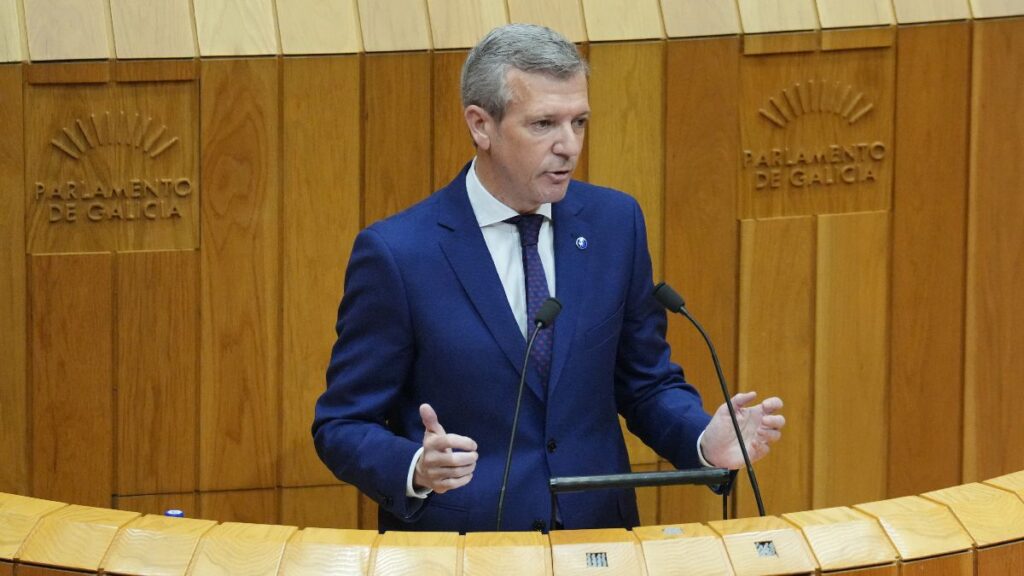
The president of the Xunta de Galicia, Alfonso Rueda, announced this Wednesday an ambitious comprehensive program aimed at increasing control over fraud in sick leave and granting a more decisive role to mutual insurance companies in the review of benefits. temporary disabilities.
During his intervention in the Debate on the State of Autonomy, which marks the halfway point of the XII Legislature in the community, the head of the autonomous Executive has placed the containment of the work absenteeism as an absolute priority for the second half of his mandate. The plan will pay special attention to musculoskeletal ailments and the processes of the so-called “minor psychiatry”, areas that concentrate the largest volume of files.
In a speech, Rueda outlined a roadmap that ranges from health and housing to the promotion of public employment and industrial policy. However, the announcement with the greatest economic and labor impact has been the reform of the temporary disability system, a direct response to the repeated warnings of the Galician business community. The president has described the situation as a “very serious problem” and has pointed out that this phenomenon hampers the productivity of the productive fabric of all of Spain, with a particularly serious incidence in the Galician territory.
To support his diagnosis, the president has presented some eloquent figures to the Galician Parliament. Galicia is currently the second autonomous community in Spain with the highest number of working days lost due to disability and, likewise, it occupies second national place in terms of the average duration of these processes, which exceed 60 days per file. The cost of this absenteeism, according to data provided by the Galician Government, exceeds 2.2 billion euros annually, which represents around 3% of the gross domestic product (GDP) of the community. In daily terms, the Xunta’s calculation estimates that 70,000 Galician citizens do not go to work because they are on medical leave.
Rueda has stated that the existence of clinical circumstances that fully justify the worker’s right to be absent is “evident”, but has insisted that the current system has wide margins for improvement. In this sense, he has pointed out the responsibility of the Public Administration itself to guarantee that “those who really need it are on sick leave” and ensure that reintegration into the labor market becomes effective when medical conditions allow it.
Specific units in primary care
The clinical axis of this future comprehensive plan, as the regional president has advanced, will consist of the creation of specialized units focused exclusively on the care and supervision of mild musculoskeletal and psychiatric pathologies. The Xunta de Galicia has not yet specified the details of the organizational structure or the cost of deploying these units, but Rueda has clarified that they will function as a support and relief mechanism for family doctors at the first level of care (primary care), who currently assume practically the entire bureaucratic and clinical burden in managing sick leave.
The objective of the measure is to provide the public health system with millimetric monitoring of those ailments that have a greater statistical impact, providing physicians with advanced monitoring tools. Rueda recalled that the Executive had previously implemented a preliminary review program that allowed nearly 130,000 files to be audited. This process, as indicated, led to the medical discharge of 30,200 people who “should not continue in that situation.” Based on this experience, the new program aims to establish automated and more agile review mechanisms.
The new role of mutuals
Alfonso Rueda has explained that, as of the implementation of the plan, when a mutual society formulates a proposal for registration that is “sufficiently justified”, the health inspection of the public system will ratify it and order the immediate incorporation of the worker. Only in cases where there are reasonable clinical doubts, the inspection will summon the employee for an in-person assessment before settling the file.
With this procedure, the Galician Administration seeks to tackle the bureaucratic bottlenecks that make casualties chronic due to the slowness in collecting evidence or complementary reports. To accelerate this flow, the Xunta will process a “global authorization” that will exempt mutual insurance companies from requesting individualized permission for each diagnostic test or rehabilitative treatment.
The decision alters the traditional balance between the control of fraud and the exclusive power of public health to resolve the health of workers. Aware of the foreseeable social response, Rueda has assured that the plan will be discussed and agreed upon with the unions and employers, with the aim of being able to apply it “as soon as possible.”
Defense of civil servants and public employment
The head of the Xunta has announced that the Council will approve in the coming weeks a new offer of public employment that will exhaust the maximum limit of the replacement rate imposed by the State, which will translate into the call for more than 800 positions in the autonomous Administration.
At this point in his speech, the leader has sent a firm message of protection towards the technicians and public employees of the Xunta. Rueda has criticized the “disqualifications and accusations” that these professionals suffer when their opinions do not conform to “certain political positions.” Although he has avoided explicitly mentioning the controversial pulp factory project of the Portuguese multinational Altri in Palas de Rei (Lugo), the message has been interpreted as a shield to the Environment technicians who evaluate the viability of a facility that has generated a strong environmental and neighborhood response.
Galician capital, innovation and primary sector
The speech has also addressed the transformation of the productive fabric. The president has announced the imminent creation of the Galtia Foundation, an entity aimed at attracting researchers and retaining technological talent. “Knowledge should not be trapped in a laboratory,” he stated, insisting on the need to transfer the scientific potential of the community to the real economy.
The primary sector, a historical pillar of the Galician economy, has occupied the final part of the debate. Rueda has guaranteed the belligerence of the Xunta against any alteration of the regulations of the Coastal Law that the central Government tries to sneak in “through the back door”, in defense of the facilities of the sea-industry complex located on the coast. Likewise, given the risk of a drop in the price of milk at source, it has warned that the Galician Competition Commission will closely monitor the dairy sector and open disciplinary proceedings in the event of any irregularity in the value chain.
Finally, in a week in which the community has already recorded major fires, the Galician leader has presented the Prevention and Defense Plan against Forest Fires in Galicia (Pladiga). This operation will increase the area of preventive action by 70% compared to the previous year and will add 170 new troops, doubling the community’s elite unit. The president closed his speech with a new claim to Madrid, demanding the definitive installation of a base for the Military Emergency Unit (UME) in Galicia and recalling the need to forge a State pact on forestry matters.