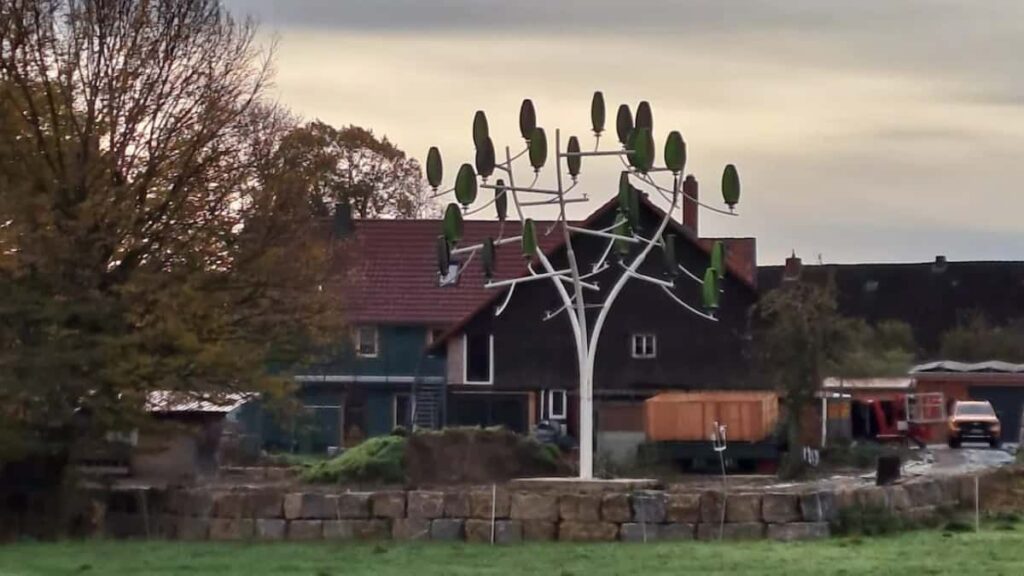
A resident of Lower Saxony, in Germany, has installed a “wind tree” in the garden of his home with 36 green microturbines that is capable of reaching a theoretical power of 10,800 watts (an average house in Spain usually has contracted between 3.45 kW and 5.75 kW). According to Focus Online, Sebastian Harms is one of the first Germans to opt for this technology inspired by the shape of a tree to produce electricity at home.
If we look at the image published in the middle, it draws attention, since it is not a natural tree, but rather a 9.8 meter high steel structure whose branches hold small leaf-shaped turbines. Each of them, known as Aeroleafsare capable of generating up to 300 watts and work independently, that is, if one fails for something, the rest continue to work and produce energy.
Sebastian Harms
The key to the system is that these vertical-axis microturbines begin to rotate with winds of about 2.5 meters per second, a low threshold compared to other conventional wind turbines. According to the manufacturer, the operation is practically silent and is designed for urban or residential environments where noise and visual integration are decisive factors.
It must be clarified that the case of Harms does not start from scratch, since it already has two photovoltaic systems of up to 10,000 watts each and understands this wind tree as a complement to move towards greater energy self-sufficiency. The logic is that, when the solar panels do not produce, especially at night or in winter, the wind can continue to provide electricity. It does all this with the goal of being self-sufficient by 2029, or in other words, producing 100% of the energy demand of its home, its office and its electric car and paying zero euros on the electricity bill.
To give us an idea, 10,000 watts is equivalent to having the air conditioning, refrigerator, washing machine, dishwasher, oven and lighting of small appliances on at the same time. On the other hand, a house usually consumes on average between approximately 8 and 12 kWh per day.
The device comes from the French firm New World Wind, successor to NewWind, and the company itself maintains that it has already deployed more than 200 “wind trees” in different parts of the world. In Germany, until now, this technology had been seen mainly in corporate or municipal facilities, not so much in private homes.
Now, the element that most determines the debate is the price. The total investment for this installation is around 70,000 euros, including foundation and electrical part. By staying below 15 meters in height, it did not need a building permit in Lower Saxony, but that does not solve the great economic mystery. Focus Online Remember that the profitability of mini wind depends greatly on the real wind available at the site and that, in unfavorable locations, payback can be very difficult compared to alternatives such as residential solar.