85% of the apples analyzed showed residues of more than one pesticide and 93% contained at least one of these substances, according to a study coordinated between the NGO Pesticide Action Network Europe (PAN Europe) and 13 other European entities. He work, released at the end of January and prepared from 59 locally produced samples collected in 13 European countries, including Spain, it also maintains that each sample contained on average three different wastes and that some contained up to seven.
The study (available at this link in English) launches a warning about the “cocktail effect”, that is, the simultaneous exposure to several chemical substances through the same food. The authors explain that this risk is still not fully incorporated into the ordinary regulatory assessment and recall that the European Regulation on Maximum Residue Limits provides for taking into account cumulative effects when appropriate methodologies exist. Even so, the European Commission specifies that in recent years it has worked with the European Food Safety Authority, EFSA, on cumulative evaluation tools and that pilot studies and methodological work have already been carried out for their gradual application.
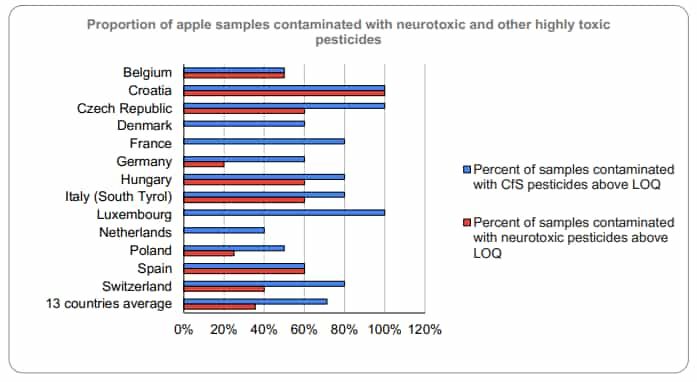
The details of the results show that 71% of the samples contained at least one pesticide classified by the EU as “candidate for substitution”, the category reserved for substances of greatest toxicological concern; 64% included at least one PFAS pesticide and 36% had residues of neurotoxic compounds. In the case of Spain, the report graph places the proportion of apples with multiple waste at 80%, in line with France and Italy, while Denmark appears as the country with the lowest incidence in that category, with one of five samples.
The document places special emphasis on infant nutrition. According to its authors, if these same apples were marketed as processed food for babies and young children, 93% would not meet the legal limit of 0.01 milligrams per kilo set by the European regulations for that type of products. PAN Europe’s own statement adds that the exposure in these cases can be “up to 600 times” higher than the threshold allowed for processed baby food.
Exhibitions in 13 countries and criticism of Brussels
The research was carried out between September 1 and 20, 2025 with samples purchased from supermarkets, markets and local points of sale in Belgium, Croatia, Czech Republic, Denmark, France, Germany, Hungary, Italy, Luxembourg, Netherlands, Poland, Spain and Switzerland. In the Spanish case, the five samples came from Mercadona and BM Urban, according to the methodological table of the report.
Martin Dermine, executive director of PAN Europe, maintains that several of the substances detected “would have been banned a long time ago” if national and EU authorities applied the law more rigorously. The statement expressly mentions acetamiprid, due to its toxicity to the fetal brain, and difenoconazole, to which it attributes endocrine disruption and neurotoxicity effects. The organization also criticizes the orientation of the European Commission’s omnibus proposal on food and feed, which in its opinion would reduce health and environmental protection.
The underlying issue, however, goes beyond a specific campaign on residues in fruit. The apple is one of the most consumed fruits in Europe and PAN Europe remembers that conventional production can receive around 30 phytosanitary treatments per year. Hence, the report combines the immediate recommendation to prioritize, when possible, organic apples and peel them if they are not, with a broader political demand: accelerate the evaluation of multiple exposure and tighten the withdrawal of the most problematic substances.